


[ad_1]
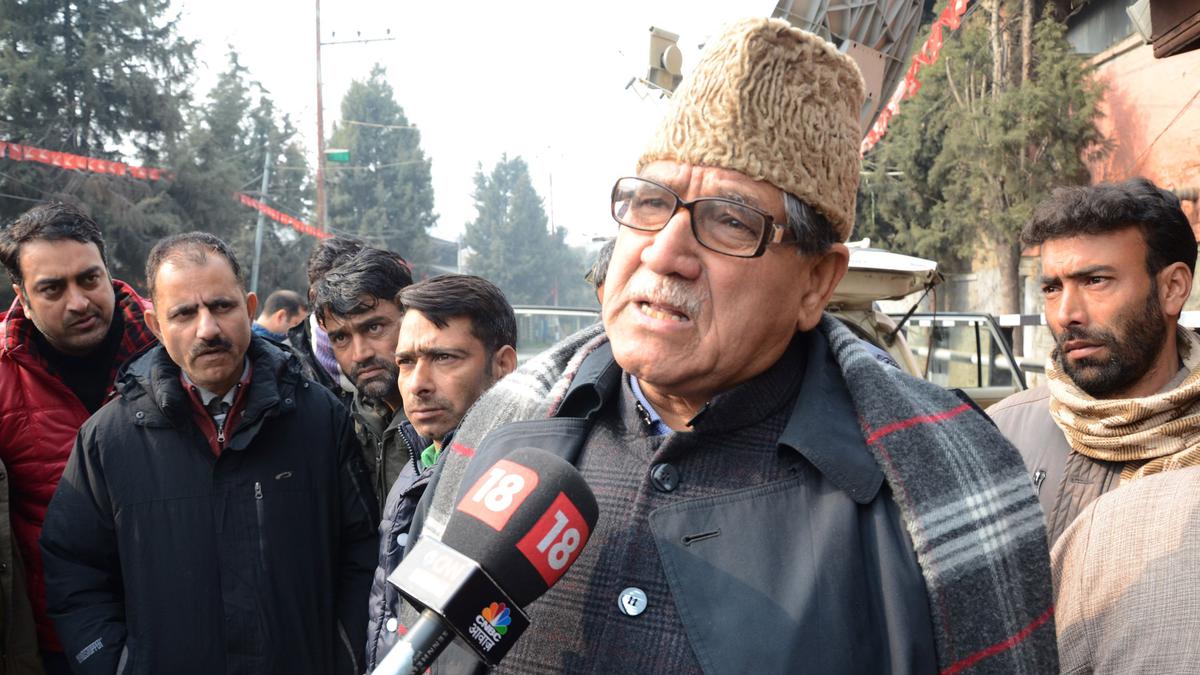
National Conference leader Mohammad Akbar Lone.
| Photo Credit: Nissar Ahmad
The Centre and other respondents accused in the Supreme Court on September 4 National Conference party leader Mohammad Akbar Lone, a petitioner in the Article 370 abrogation challenge case, of raising slogans, including ‘Pakistan Zindabad’, in the Jammu and Kashmir Assembly in 2018 and still feeling remorseless about it.
Also read | SC hearing on Article 370 live updates | Day 15
Appearing before a Constitution Bench headed by Chief Justice of India, Solicitor General Tushar Mehta, for the Union government, demanded that Mr. Lone should be made to file an affidavit pledging his allegiance to the Constitution of India.
He urged the Supreme Court to act, saying if nothing was done, it might encourage others and “the efforts of the nation to bring normalcy, which has been substantially successful, will be affected”.
Mr. Mehta said Mr. Lone was no ordinary person but currently a sitting Member of Parliament. “Such comments coming from responsible leaders have its own context and seriousness,” the law officer submitted.
The Solicitor General said Mr. Lone would have been the lead petitioner following the withdrawal of Shah Faesal, had the court not given the generic title ‘In Re Article 370 of the Constitution’ to the case.
“He (Lone) should file an affidavit saying that ‘I owe allegiance to the Constitution of India because I am before the highest court of the country’. He must say ‘I strongly oppose terrorism and secession by Pakistan in Jammu and Kashmir’… He must come on record,” Mr. Mehta said in an impassioned manner.
Appearing for other respondents supporting the Centre’s move to repeal Article 370, senior advocates Rakesh Dwivedi and Mahesh Jethmalani said “if he is invoking the Constitution of India here, he cannot stand outside the Constitution of India… It is a matter of propriety”.
Mr. Mehta even said the court should “take up” the submissions of Mr. Lone, who was represented by senior advocate Kapil Sibal, only if he “apologised”.
Chief Justice Chandrachud said the judges had seen these reports in the newspapers.
“We also read the newspapers. Lot of things in affidavits are pre-empted by giving them in newspapers… We will see what they (Lone’s lawyers) have to say about this issue in their rejoinder,” Chief Justice Chandrachud addressed the government and other respondents.
Mr. Sibal, in the opening days of the challenge to the repeal of Article 370, argued that the President of India had no blanket powers to silence the will of the people of J&K through a series of executive acts which abolished the Statehood of J&K and abrogated Article 370.
“There has been no representative democracy in J&K in the past five years… In the guise of restoring democracy, we have decimated democracy. The State of J&K historically represented a unique relationship unlike princely states which integrated into the Union,” he had asked the court.
Mr. Sibal had questioned the procedure by which the Parliament assumed the role of the legislature of J&K in place of the J&K Constituent Assembly in order to abrogate Article 370.
[ad_2]
Source link
