


[ad_1]

NEW DELHI: China’s aggressive expansionist behaviour in the Indo-Pacific loomed large at a conclave of top military officers from more than 30 countries here on Tuesday, with defence minister Rajnath Singh, the Indian and US Army chiefs and a few others stressing the need for greater collaboration to keep the region free, open and secure while respecting the territorial integrity of all nations.
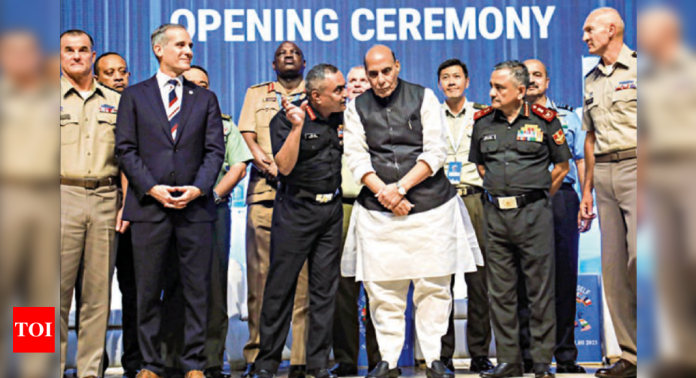
There was no direct reference to China publicly during the opening ceremony of the two-day 13th Indo-Pacific Armies Chiefs’ Conference (IPACC) being co-hosted by the Indian and US Armies. But there were enough veiled references and informal conversations to underline the grave concerns over Beijing’s muscle-flexing, stretching from the South China and East China Seas to the land frontier with India in the critical Indo-Pacific region, which accounts for 65% of the global population, 63% of the GDP and 50% of the maritime trade.
Army chief General Manoj Pande, for instance, said, “While efforts by countries are converging towards effecting a free and stable Indo-Pacific, yet we are witnessing manifestations of inter-state contestations and competitions.”
In another obvious reference to China, Gen Pande said that apart from challenges in the maritime domain, the Indo-Pacific also faced a wide range of security and humanitarian concerns on land as well, including “artificially expanded islands to acquire real estate and establish military bases”.
This came in the backdrop of China steadily basing anti-ship and anti-aircraft missiles, fighters and other military hardware on islands it has built in the South China Sea, where it is locked in territorial disputes with its neighbours.
“Our outlook emphasises respect for sovereignty and territorial integrity of all nations in the region, equality of all, peaceful resolution of disputes, avoidance of use of force and adherence to international laws, rules and regulations,” Gen Pande said.
Singh, in turn, called for “collective wisdom and concerted efforts” to deal with the complexities and challenges in the Indo-Pacific to ensure a future marked by prosperity, security and inclusivity in the region.
Indo-Pacific is no more just a maritime construct, but a full-fledged geo-strategic construct now, and the region is facing a complex web of security challenges, including boundary disputes and piracy, he said.
Pointing out that countries must recognise that global issues involve multiple stakeholders and no one nation can address these challenges in isolation, he said India’s efforts towards building robust military partnerships with friendly countries underscore its commitment to not only safeguard national interests, but also address global challenges faced by all.
There was no direct reference to China publicly during the opening ceremony of the two-day 13th Indo-Pacific Armies Chiefs’ Conference (IPACC) being co-hosted by the Indian and US Armies. But there were enough veiled references and informal conversations to underline the grave concerns over Beijing’s muscle-flexing, stretching from the South China and East China Seas to the land frontier with India in the critical Indo-Pacific region, which accounts for 65% of the global population, 63% of the GDP and 50% of the maritime trade.
Army chief General Manoj Pande, for instance, said, “While efforts by countries are converging towards effecting a free and stable Indo-Pacific, yet we are witnessing manifestations of inter-state contestations and competitions.”
In another obvious reference to China, Gen Pande said that apart from challenges in the maritime domain, the Indo-Pacific also faced a wide range of security and humanitarian concerns on land as well, including “artificially expanded islands to acquire real estate and establish military bases”.
This came in the backdrop of China steadily basing anti-ship and anti-aircraft missiles, fighters and other military hardware on islands it has built in the South China Sea, where it is locked in territorial disputes with its neighbours.
“Our outlook emphasises respect for sovereignty and territorial integrity of all nations in the region, equality of all, peaceful resolution of disputes, avoidance of use of force and adherence to international laws, rules and regulations,” Gen Pande said.
Singh, in turn, called for “collective wisdom and concerted efforts” to deal with the complexities and challenges in the Indo-Pacific to ensure a future marked by prosperity, security and inclusivity in the region.
Indo-Pacific is no more just a maritime construct, but a full-fledged geo-strategic construct now, and the region is facing a complex web of security challenges, including boundary disputes and piracy, he said.
Pointing out that countries must recognise that global issues involve multiple stakeholders and no one nation can address these challenges in isolation, he said India’s efforts towards building robust military partnerships with friendly countries underscore its commitment to not only safeguard national interests, but also address global challenges faced by all.
[ad_2]
Source link
