


[ad_1]

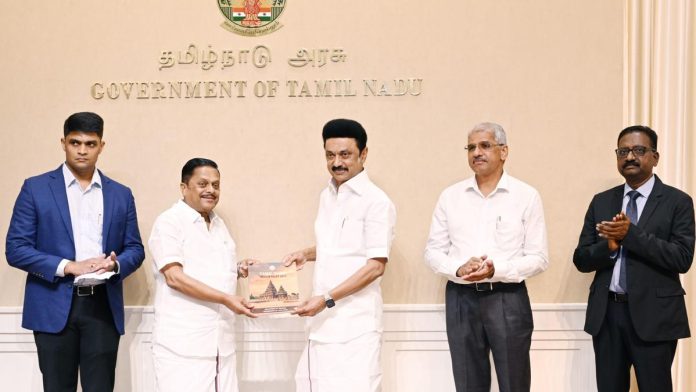
Tamil Nadu Chief Minister M. K. Stalin released ‘Tourism Policy 2023’. Tourism Minister K. Ramachandran received the first copy of the Policy.
| Photo Credit: Special Arrangement
Tamil Nadu Chief Minister M. K. Stalin, on September 26, released ‘Tourism Policy 2023’ which aims to attract investments of ₹20,000 crore into this sector over the next five years.
The comprehensive policy envisions both enhancing and upgrading the existing tourism infrastructure, along with the establishment of new, greenfield projects. This policy will be valid for a period of five years from the date of the policy notification, or till a new policy is announced. The Department has also set targets for the next five years which includes contributing to at least 12% of State Gross State Domestic Product (GSDP) annually and tourism and its supporting industries will employ 25 lakh people in Tamil Nadu.
The policy also highlighted that a Tourism Facilitation Cell will be created within the Department to assist Guidance Tamil Nadu (the nodal agency instrumental in bringing investments into the State) to monitor and promote tourism investment. The Cell will work towards investment promotion, facilitation and monitoring of private sector investment in tourism, including attracting fresh investments in the tourism sector. A dedicated segment for tourism will be created at the upcoming Global Investors Meet (GIM) 2024, with the objective of illustrating the investment potential of Tamil Nadu tourism to the investor community.
Under this policy, the Department will support private sector investments across tourism projects located in certain geographies titled “Focus Tourism Destinations” and certain corridors titled “Focus Tourism Corridors” only.
The Department is planning to create one large-format amusement park, similar to global theme parks such as Disney and Universal Studios, with an area of at least 100 acres on the out-skirts of Chennai. The amusement park will be developed through private sector participation. Plans are on cards to launch cruise facilities on various stretches on the Chennai – Rameswaram – Kanniyakumari and Chennai – Port Blair route. Jetty infrastructure will be developed at these places after identification of suitable spots.
The policy also mentions that existing towns and cities with good quality urban infrastructure will be developed as Gateway Hubs, from where the visitor to Tamil Nadu can initiate their journey. Chennai, Tiruchi, Madurai, Coimbatore and Kanniyakumari will be developed as gateway hubs. An allocation of 5% from the smart city funds will be dedicated to enhancing tourism infrastructure in primary Gateway Hubs.
The State is also looking at enhancing Golf tourism and Sports tourism. The Tourism Department will engage with golf courses located in hilly regions for the development of accommodation facilities, which can be promoted as part of recreation tourism. Sports tourism is one of the fastest growing forms of recreation tourism. This includes tourists traveling to participate actively in sports as well as to attend sports events. The Department will engage with the operators of key sports properties in the State to assist and align marketing efforts.
The Department envisages to promote film tourism across all segments – Bollywood, Kollywood, Documentaries, TV Productions, Foreign Movies and Shows and other regional movies. A Film Tourism Scheme will be separately launched outlining guidelines and incentives for film shooting in Tamil Nadu.
Feasibility of development of a Marina and launch of cruise operations from Kovalam will also be evaluated. Rameswaram and Kunthukal islands offer unexplored marine life which offer opportunities for underwater and aquatic sports for tourists. Activity operators’ licenses will be issued by the Department for operating scuba diving and snorkeling activities at these locations. Beaches such as Kovalam, Rameshwaram and Ariyaman are most suitable for sea-side water-based activities including surfing, speed boats, water-skiing, etc. Water-sports infrastructure will be encouraged to be set-up by private operators across these locations.
Concessions in electricity tariff
The Tamil Nadu Tourism Policy, 2023, provides for a single-window portal for necessary clearances, concessions in electricity tariff and other incentives for eligible tourism projects. It also envisions a Tourist Security Organisation.
“New hotel projects in focus tourism destinations will be eligible for electricity tariff rebate (i.e. the difference between commercial tariff and industrial tariff) for a maximum period of three years subject to the condition that the rebate shall not exceed 10% of the eligible investment in fixed assets,” the policy said.
Tourism Minister K. Ramachandran received the first copy of the policy, which envisions deploying of trained personnel to ensure the tourist security at all major tourist destinations across the State. “They shall be trained in languages, tourist etiquette, behaviour and other requited soft skills.”
A feedback-based rating, activity operator license, registration, accreditation and categorisation of tourism enterprises are among the other features envisioned in the policy. The tourism projects are to be categorised as A (investment in eligible capital assets up to ₹50 crore), B (investment in eligible capital assets up to ₹200 crore) and C (investment in eligible capital assets more than ₹200 crore).
The policy provides for capital subsidy up to ₹1.5 crore, additional capital subsidy in the form of reimbursement of an additional share of investment in eligible capital assets. It also provides for interest subvention, payroll incentive, quality certification incentive, sustainability initiatives incentive, among others. Click here to have an access to the copy of the Tamil Nadu Tourism Policy, 2023.
[ad_2]
Source link
